As an immersion in the construction world, Terragraphy is an invitation to distance ourselves from energy-intensive and polluting materials such as concrete to discover the raw earth alternative.
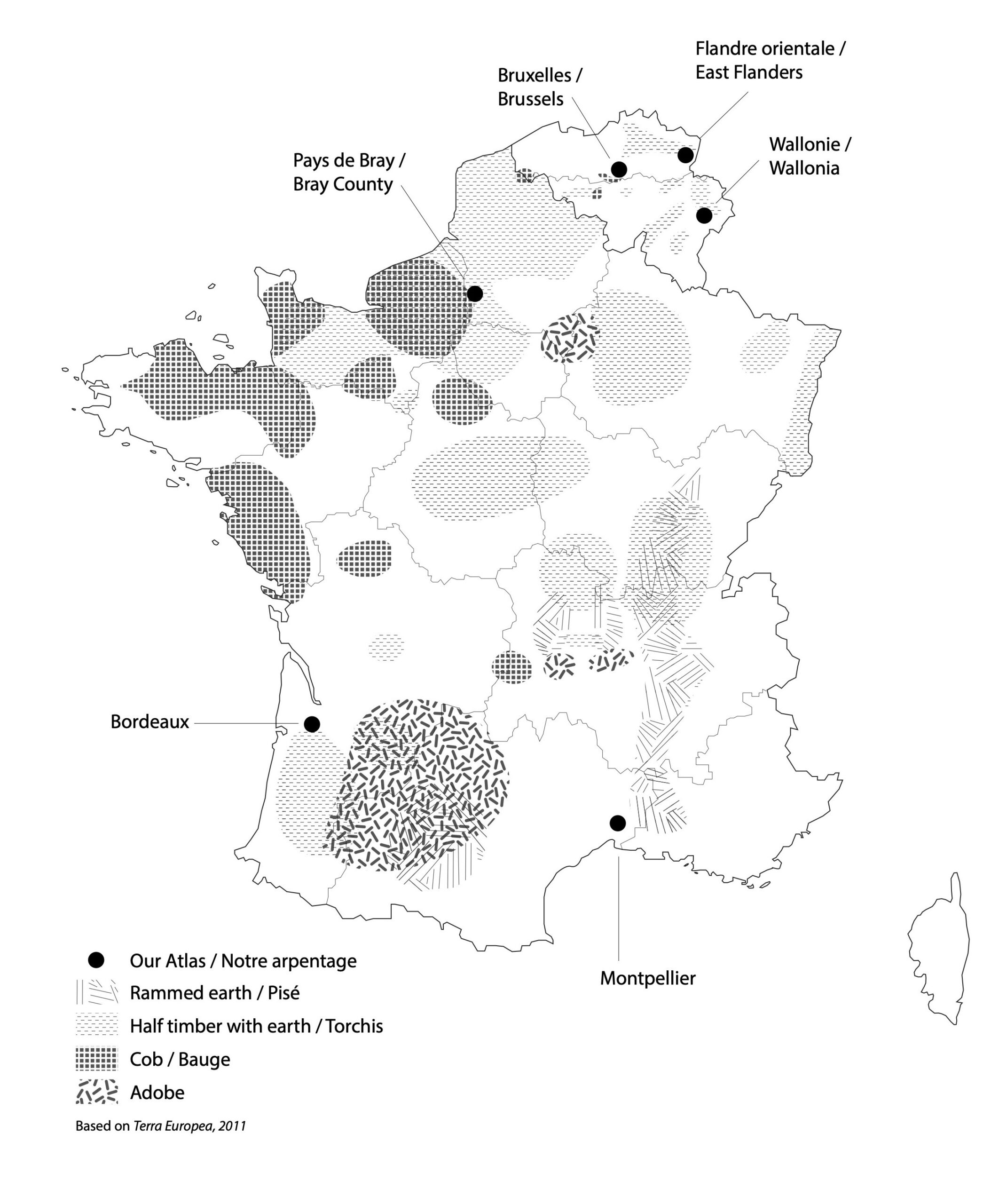
Wishing to transmit the desire to put our hands in the earth to reconnect with this living body that has vanished beneath the asphalt of our cities, Cinzia Romanin and Thomas Noceto went, since 2021, to meet inhabitants in the Belgian and French territories, whose built heritage is rich with earth-based constructions that have stood the test of time. Fighting against lobbies and regulation laws, those people are defending a local material with many virtues which can be reshaped ad infinitum and still reintegrated into its original soil without any alteration. As an atlas of the world of raw clay craftsmanship, this project reveals a relatively unknown imagery made up of vernacular tools, specific gestures transmitted from generation to generation and reused excavated soils which are still too often considered as waste by the industry.
Inspired by Lavoisier’s idea that “Nothing is lost, nothing is created, everything is transformed”, this visual research proposes to enhance raw earth as a creative body. In this sense, by using handcrafted clay-made films and earth pigments prints, this project has then been an opportunity to invent sensitive explorations by revealing each landscape through its own materiality.
A part of this project was made possible thanks to an artistic residency in the Bray county organised by the Diaphane photographic center and funded by the French Ministry of Culture.
Terragraphie
En collaboration avec Thomas Noceto
Telle une immersion dans le monde de la construction, Terragraphie nous invite à nous distancer de matériaux énergivores et polluants tels que le béton pour découvrir l’alternative de la terre crue.
Souhaitant transmettre l’envie de mettre les mains dans la terre pour renouer avec ce corps vivant disparu sous l’asphalte de nos villes, Cinzia Romanin et Thomas Noceto sont, depuis 2021, partis à la rencontre d’habitants sur le territoire franco-belge dont l’héritage bâti regorge de constructions centenaires issues de ces savoir-faire. Luttant contre divers lobbys, normes, et régulations en tout genre, ces personnes défendent une matière locale aux multiples vertus pouvant être remodelée à l’infini ou simplement réintégrée à son sol d’origine sans aucune altération. Tel un atlas du monde de l’artisanat de terre crue, ce projet révèle ainsi une imagerie relativement peu connue, faite d’outils vernaculaires, de savoir-faire transmis de génération en génération et de réemploi de terres d’excavation encore trop souvent considérées comme des déchets par l’industrie.
Inspirée par l’idée de Lavoisier selon laquelle « Rien ne se perd, rien ne se crée, tout se transforme », cette recherche visuelle propose d’appréhender ce matériau en tant que corps vivant et substance créatrice. C’est ainsi qu’en photographiant à l’aide de négatifs artisanaux composés d’argile et en réalisant des impressions à base de pigments de terre, ce projet a été l’occasion d’imaginer des explorations sensibles permettant de révéler chaque paysage au travers de sa propre matérialité.
Une partie de ce projet a été rendue possible grâce à une résidence artistique organisée dans la région du Pays de Bray par le centre photographique Diaphane et financée par le ministère français de la Culture.